Beyond the Boat: How Sport Shaped Tashi’s Future
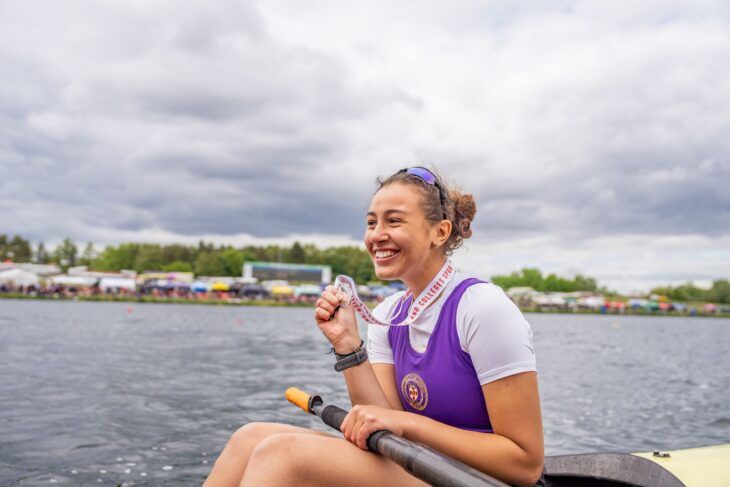
Sport can shape far more than performance — it can shape confidence, identity and future ambition.
As part of our Women in Sport series, we spoke to Tashi, one of our Next Steps Bursary students about her journey from KAA student to rowing coach, and how sport helped her navigate both education and life beyond school.
From teamwork and resilience to coaching the next generation, her story reflects the wider impact sport can have on young women and their futures.
Amount of time at KAA?
I attended KAA for 8 years from 2016 to 2023
How long have you been on the Next Steps Bursary programme?
Since 2023!
Rowing – how did your interest in rowing start? Did your journey with rowing begin before you joined an Aldridge school, or was it the school’s offering that first got you onto the water?
My interest in rowing started in year 9 when I started attending KAAs rowing program on a Friday morning.
How did your school support this sport? In what specific ways did the school support your dual-path (sport and studies)?
They provided me with a pathway into rowing outside of school. As well as giving me time off to compete when necessary. In six-form, when both rowing and school started to demand more, and I asked for help in my paper 1 Physical Education A level, the teachers gave me tutoring on aspects that I found difficult.
Which of the Aldridge Attributes—Passion, Determination, Problem Solving, Risk Taking, Teamwork, or Creativity—do you find yourself leaning on most during sporting activity
For rowing, I learned the most about teamwork, as it required the whole crew to move together perfectly.
We are sorry to hear you are injured, but it is incredible that you are coaching others – tell us more about what you are doing.
I work at Fulham Reach Boat Club (FRBC) as a coach, teaching people of all ages to row. Part of this includes taking KAA students out on the water and helping introduce more young people from state schools to the sport.
I also recently helped run the Youth Boat Races through FRBC, parts of which aired on Channel 4 during the Boat Race coverage. It was fantastic to see KAA students perform so strongly and achieve a brilliant win in the competition. The event helped raise awareness of Fulham Reach’s work and inspired more young people to get involved in rowing.
Do you use any of the Attributes you have learnt in a different way now you are coaching others?
Yes, although teamwork still plays a big role, problem-solving is definitely more important in making me a good coach.
Third year of university is notoriously intense. How do you manage the “mental juggle” between your dissertation/finals and your commitments at the rowing club?
Although I am no longer rowing, I am still training for a triathlon, and a key thing I have found is that starting early is really important if you want to train and do well in university.
Would you say sport is a part of your identity you simply couldn’t do without, regardless of whether you are competing or coaching?
Definitely, although I am not rowing anymore, I still spend over 10 hours a week at my old boat club as a coach. I have decided to take up triathlon, to try something a bit different!
Does having a sporting life help focus in your academic life?
I am more willing to sit down and focus after a run this was the same when I rowed. I found that the standard of my work improves as I have had time to think and take a break. During stress full times such as A levels I found rowing on the river a break from revising. By taking this break gave me the motivation to revise and do it more effectively. Also, due to the fact that I took PE, it allowed me to link sports to the content I was learning. Now at university it provided me with more structure, as it doesn’t offer much.
Long-Term Goals, tell us more about your long-term goals
I want to work as a policy and public affairs manager in a charity. Fulham Reach Boat Club is what inspired me to pursue this goal, being a member and a coach there I made me interested in the polices which have allowed Fulham Reach to become successful and ask how polices can help support them. I have found that doing sports helps me manage my stress and I intended to do sporting events to provide me with clear aims during work.
The Impact of the Bursary: How has being on the Next Steps Bursary program specifically helped you navigate university or sports?
It has given me lots of networking opportunities; I have been able to meet people from other courses and universities, as well as a range of industry professionals. It has also allowed me to be part of a community where I can ask questions when I need to.
What would you say to a student at an Aldridge school right now who is trying to decide if they can “make it” in both their sport and their academics?
That, if you want, you can! There are so many ways to make it work, and if you need help, there are always people to reach out to.
What advice would you give a student who may be considering applying for the Next Steps Bursary?
There is no harm in applying; you will not get it if you do not try.